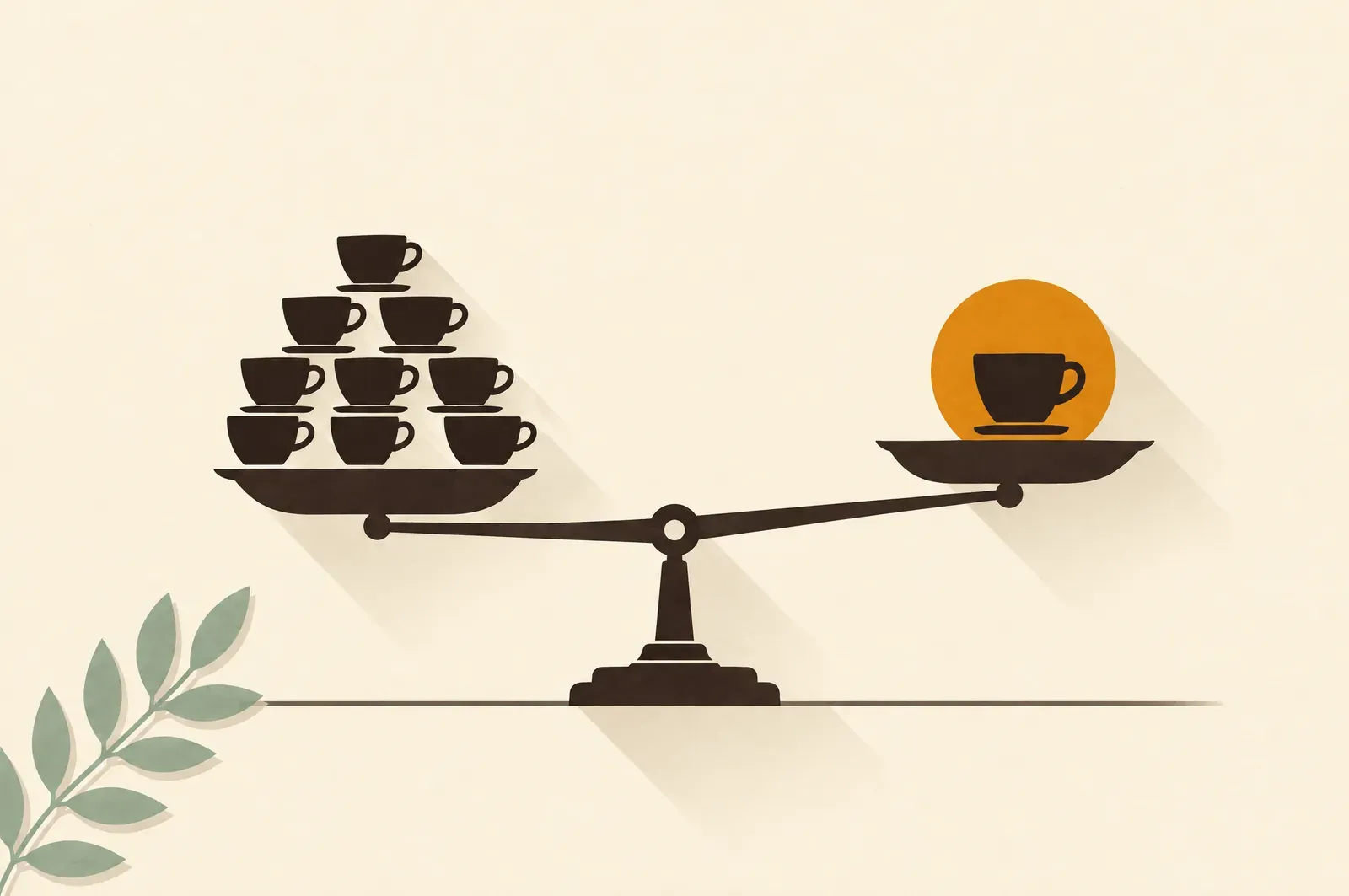
A stamp card is worth it when extra or retained visits earn more than the rewards and running costs. Here’s how to work out how many visits your café, bakery or salon needs to cover them.
The formula: how many extra visits do you need?
Monthly programme costs ÷ contribution per extra visit = extra visits needed. Round the result up to a whole visit.
Programme costs include rewards, your plan fee and extra work. Contribution means your net selling price minus the variable costs of the visit. Use your own figures.
What the reward costs
For this calculation, assume a free coffee replaces no paid purchase and needs no extra staffing cost. All figures are net, excluding VAT.
- Net selling price per cappuccino: €3.20.
- Beans, milk and other ingredients: €0.65.
- Contribution per additional cappuccino sold: €2.55.
Ten paid coffees produce €32 in net revenue before the free coffee costs €0.65 in ingredients. That is just over 2 percent of revenue. For the guest, one in eleven coffees is free: a saving of just over 9 percent.
If the free coffee replaces a paid purchase, add the lost contribution to your programme costs too. That gives you a fuller calculation for your shop.
The hidden cost: guests who’d have come anyway
Budget for rewards earned by people who already visit regularly. Your regular gets her cappuccino at half past seven every morning, with or without a card. Her free coffee is a thank-you, not an extra visit.
The key question is: does the card bring enough extra visits to cover all rewards, including those for guests who would have come anyway?
Let’s run it for a small café. Say you have 40 regulars with a card, coming in three times a week on average:
- 40 guests × 3 visits = 120 stamps a week
- At 10 stamps per reward, that’s 12 rewards a week, about 52 a month
- 52 × €0.65 = about €34 a month in cost of goods for rewards
€34 divided by €2.55 margin per visit means 14 extra visits a month cover the rewards’ cost of goods in this example. Including €7.99 for Start, round up to 17 extra visits before any other costs. The plan price excludes VAT. Across 40 regulars, that is less than one extra visit per person every two months.
Three businesses, three very different results
Coffee has a low cost of goods. Service businesses work differently. Here are three examples using sample net figures:
| Café | Bakery | Hair salon | |
|---|---|---|---|
| Reward | Cappuccino after 10 stamps | Loaf after 10 stamps | 50 % off a haircut after 6 stamps |
| Revenue before the reward | 10 × €3.20 = €32 | 10 × €4.00 = €40 | 6 × €40 = €240 |
| What the reward costs | approx. €0.65 in goods | approx. €0.90 in goods and oven | €20 in lost revenue |
| Share of revenue | about 2 % | about 2 % | about 8 % |
The café and the bakery give away goods whose cost is a fraction of the price. The salon gives away revenue: the haircut takes the same working time whether it’s paid in full or at half price. A price reduction therefore directly reduces what the appointment earns.
The alternative is a reward with an actual cost of goods instead of a price cut. A conditioning treatment or a ten-minute head massage, a care product from your own shelf, a beard line-up at the barber’s. Choose an extra with known product and time costs that fits your appointment schedule. More on stamp logic for salons is on the hair salon industry page.
What the card itself costs
Paper cards cost printing and reprinting. What they lack is an overview of cards in circulation and redemptions, leaving you without the figures for this calculation in your shop. Read the full paper vs. digital stamp cards comparison.
A digital loyalty card like Treubar costs nothing for up to 20 customer passes, with no fixed end date. After that, the Start plan for €7.99 a month, incl. VAT, lifts the limit. At €2.55 contribution per cappuccino, four extra sales cover the plan fee.
When a stamp card isn’t worth it
We would advise against a stamp card in these cases:
- Almost only one-off visitors. If almost all your customers are passing through, they have little opportunity to return. The card costs you little there, but it brings little too. Good Google reviews help you more, because they decide who walks in at all.
- Razor-thin margins. If each purchase leaves you only a few cents, every reward turns into a maths problem. Pick a reward from a part of your range with a better margin, or skip it.
- Nobody on the team is on board. A card nobody offers and nobody stamps costs hardly any money, but it doesn’t keep anyone either. The real effort is the routine at the counter, not the subscription.
How to check after three months whether it works
Compare costs and return visits over several weeks. These three steps give you a basis for your next decision:
- Work out the cost: rewards redeemed × cost of goods, plus your plan fee and extra work. Include lost contribution if rewards replace purchases that would otherwise have been paid for.
- Look at return visits: check the stamp log to see whether stamps were awarded on separate visits. Starter stamps and double stamps do not count as extra visits. The stamp count alone therefore does not tell you how often a guest came in.
- Check the gaps: look at the intervals between separate visits in the stamp log. Shorter intervals can be a hint; on their own, they do not prove that the card caused extra visits. Include cards that are not full yet, so you are not only looking at the keenest collectors. For the research background, see the psychology of stamp cards.
Checks 2 and 3 need data for each card from the customer list and stamp log, both available from Start. The overview in your loyalty card analytics shows cards and stamps on Free.
And if the numbers say something different than you expected, adjust the stamp target or the reward. How to find the right stamp count is in how many stamps should your card have?
Frequently asked questions
How much of a discount am I giving with a stamp card?
From the guest’s side: one reward divided by all purchases including the reward. With “10 stamps, then one free,” that’s one in eleven, just over 9 percent. From your side: the reward’s cost of goods divided by the net revenue up to that point. In the café example, just over 2 percent.
Should the reward be a product or a discount?
Almost always a product. A €5 discount costs you €5 in revenue. For a product worth €5 on the menu, start with its cost of goods. Extra work and a possible lost sale come on top, as explained in the assumptions above. A concrete product also feels more tangible to your guest than a percentage.
What about cards that never fill up?
Without a redemption, there is no reward cost. Still, budget for cards that people complete. A card designed so that hardly anyone completes it saves you rewards, but it doesn’t bind anyone either. Good cards fill up, in weeks or a few months.
Work out your first reward
Write down your net selling price, reward cost and stamp target. With Treubar, you can set up the card free and try the routine with up to 20 customer passes. Then use your actual redemptions for the next calculation. Or enter your own figures in the stamp card calculator.