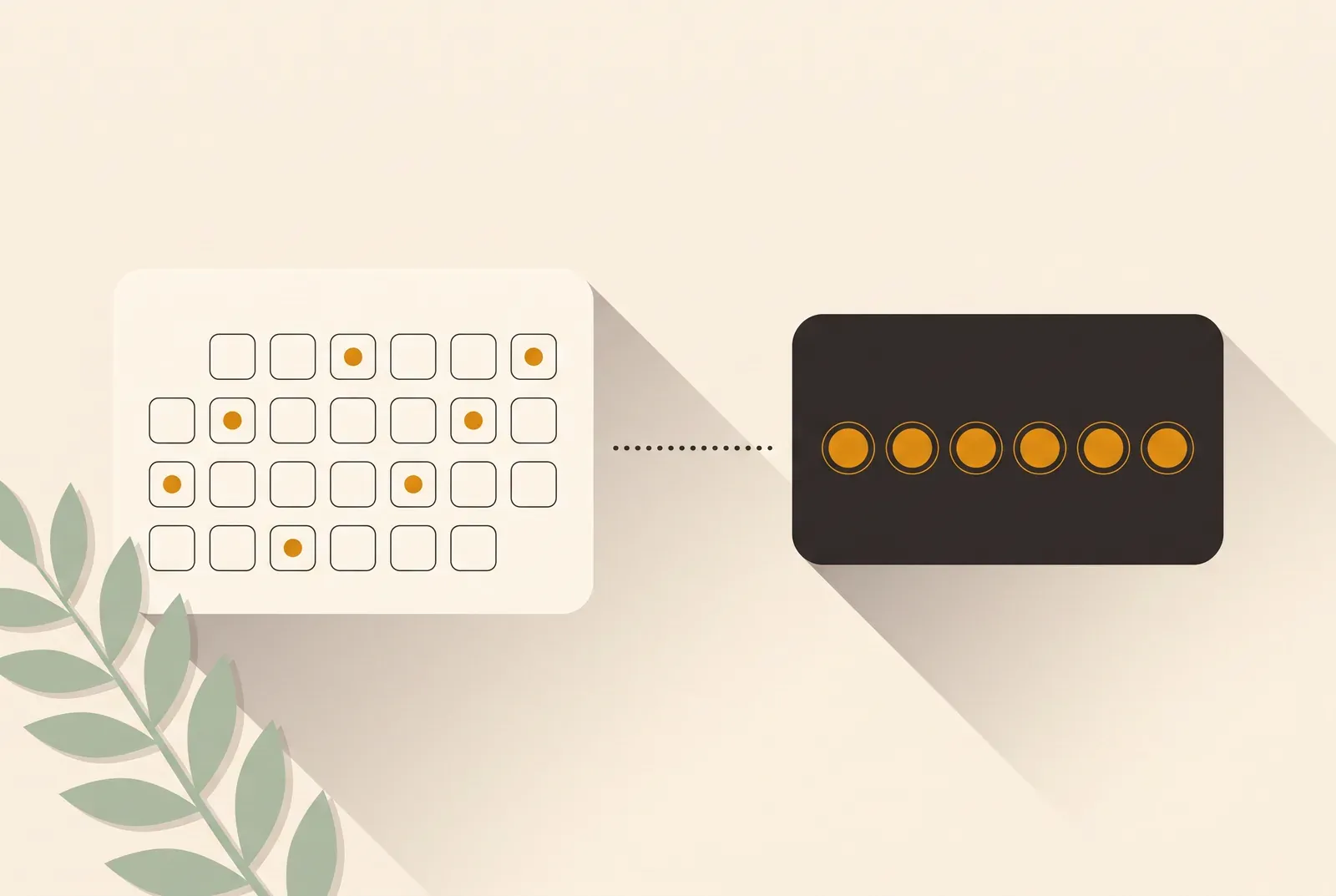
How many stamps your loyalty card needs depends on how often customers visit: ten may suit a café, while five or six can make more sense for a salon. A simple calculation helps you choose a reachable target that fits your reward.
The one formula you need
Divide the stamp target by typical visits per week to find the time needed to fill the card:
Stamp target ÷ visits per week = weeks to the reward.
10 stamps at five visits a week fill a card in two weeks. With one visit a month, the same 10 stamps take ten months. Consider whether the reward is worth that long a wait for your customers.
You can work backwards too: visits per week × desired weeks to the reward = stamp target. Two visits a week over four weeks gives you a target of eight stamps.
| Business | Visit frequency | Stamp target | Approximate collecting time |
|---|---|---|---|
| Café | 5 times a week | 10 | 2 weeks |
| Bakery | 3 times a week | 10 | 3–4 weeks |
| Salon | Every 6 weeks | 5–6 | 7–8 months |
| Ice cream shop | Once a week | 5 | 5 weeks |
| Gym | 2–3 times a week | 12 | 4–6 weeks |
This assumes one stamp per visit. Then choose a reward whose cost fits the paid visits needed to earn it.
Cafés: the classic ten
A morning coffee regular visits four or five weekdays. A 10-stamp card fills in a good two weeks. The rule: after ten paid coffees, the next one is on the house.
For customers visiting twice a week, eight or six stamps bring the reward closer. Weigh it against the paid coffees beforehand and check your margin. See the routine on the café industry page.
Bakeries: high frequency, small reward
At three visits a week, ten stamps take around three to four weeks. A customer buying rolls every weekday reaches the same target in two weeks. A loaf of their choice can be a suitable reward.
“One stamp from €5” adds unnecessary arithmetic to the early shift. At seven in the morning with a full queue, “one visit, one stamp” is faster. Whether bread, rolls or coffee to go makes a viable reward depends on your range. The visit rule stays the same. See the routine on the bakery loyalty card page.
Hair salons: where ten becomes a trap
Haircuts happen every five to six weeks, often less frequently. At one visit every six weeks, 10 stamps take about 60 weeks: well over a year. This is where a ten-stamp card becomes a trap.
Five or six stamps shorten the wait. Six visits at six-week intervals take about eight months. The reward can be more generous because one visit is worth more than a coffee. See the industry page for hair salons and barbershops.
Ice cream shops: allow for the season
Ice cream shops plan around half a year: busy from April to September, idle in winter. A customer starting late may not reach a high target before the break. Allow for the season remaining.
An extra scoop after five stamps is reachable within a few summer weeks. A family visiting weekly fills the card in about a month, before the season ends. Short targets suit impulse purchases: nobody wants a long wait for ice cream or its reward. See the industry page for ice cream shops.
Gyms: the goal is showing up
Gym members already pay a subscription. The card rewards showing up: 12 stamps, one per check-in. Two or three sessions a week fill it in four to six weeks.
A reward such as a month’s upgrade is meant to help through the first weeks, while a training routine is still forming. Each stamp shows persistence. The card offers motivation more than a discount. See the check-in approach on the industry page for gyms.
Starter stamps: make progress visible from day one
Free starter stamps make the target feel closer without changing the remaining effort. The café field study by Kivetz, Urminsky and Zheng (2006) found that customers filled cards with starter stamps faster, even with the same remaining effort. A card at “2 of 12” needs the same ten visits as “0 of 10”. It feels underway, and people dislike abandoning something they have started.
You can issue a 12-stamp card with two starter stamps instead of an empty 10-stamp card. You really give away two stamps and help customers finish the card. Use the head start as a nudge, not a permanent discount.
Frequently asked questions
How many stamps are right, in general?
In the examples above, cafés and bakeries with high frequency sit around 10, ice cream shops around 5 because of the season, hair salons 5 to 6 because of the slow rhythm, and gyms around 12 as a motivation anchor.
What if my regulars come in at very different rates?
Use your regulars’ visit frequency, not one-time visitors. The card rewards their return. Fast collectors should finish sooner: that is the aim, not a loss.
Can I change the stamp target later?
Paper needs a reprint. Digitally, change the count and reward in the app; nobody needs a new card. See choose your reward and stamp goal. Cards with stamps keep their target until full and redeemed. New cards and later rounds receive the new value. Treubar’s Free plan lets you test at no cost and adjust the target after a month or two based on your figures.
Isn’t the reward too generous if the card fills up fast?
Divide the direct cost of the reward by the paid visits needed to earn it. That gives the reward cost per visit. Include the work involved and check that your margin covers it. If the cost is too high, choose a less costly reward or raise the target.
Put your stamp target into practice
Set your target and reward in minutes with Treubar. Start your stamp card free with up to 20 customer passes and a card in Apple Wallet or Google Wallet, with no extra app for your guests.