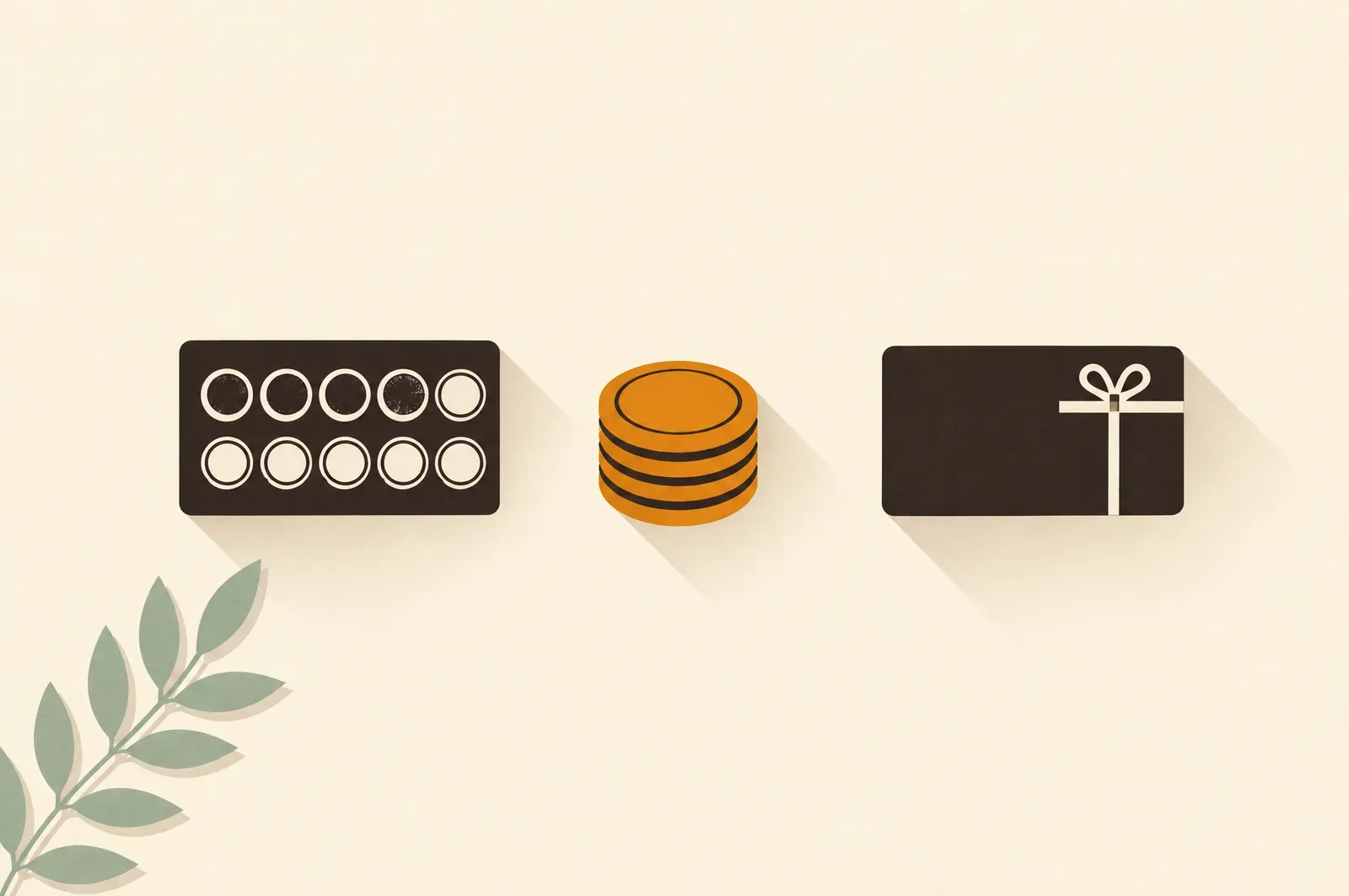
Choose a stamp card to reward frequent visits, or points when customers spend very different amounts. Prepaid credit suits regulars who prefer to pay in advance; here is how to choose the right model for your shop.
Three models, three promises
- Stamp card: “Come back often.” Every visit counts the same, however much it brings in. After a fixed number of stamps, there’s a concrete reward.
- Points scheme: “Spend more.” Points per euro, a reward once you pass a threshold. A €40 purchase counts eight times as much as a €5 one.
- Prepaid credit: “Pay up front.” The guest tops up €50, for example, and gets €55 in credit. What’s rewarded is that they trust you with their money before spending it.
Stamp card, punch card, loyalty card: what’s the difference?
The names often overlap. What matters is what the card counts:
- Stamp card: counts visits. One visit, one stamp, and after a set number there’s a reward. On paper with an ink stamp, digitally with a scan.
- Punch card: the same thing, in American English. The card gets a hole punched instead of a stamp.
- Loyalty card: the umbrella term for any card that rewards coming back. A stamp card is a loyalty card, and so is a points card.
- Points card or rewards card: usually means points per euro spent, the model supermarkets and drugstores use. In German shops it often goes by “Bonuskarte”.
- Ten-visit pass: not a stamp card at all but a prepayment, as at a lunch spot or a sauna.
Choose by the mechanism: visits, spending or prepayment. The name is a matter of taste. “Stamp card” describes the action; “loyalty card” is familiar to most English speakers. For what the terms mean, see the guide to the digital loyalty card.
The one question that usually decides it
How much do your purchases vary?
For similar purchases such as coffee, bread rolls, haircuts or car washes, a visit is a good measure of loyalty. A stamp card fits.
If one customer spends €6 one day and €80 the next, a stamp rewards both equally. Big spenders may feel overlooked. In delis, wine shops, florists and bookshops, these differences favour points.
Compare typical purchases from your own shop. If one stamp per purchase would feel fair to your customers, you may not need a points conversion at all.
Stamp card: strong on frequency
What it does well: Customers and part-timers understand it straight away. Stamping takes seconds, even at seven in the morning with a queue. A visible goal makes progress tangible. In a café study, customers collected faster as they approached the reward. The research by Kivetz, Urminsky and Zheng (2006) showed this. Read more in the psychology of stamp cards.
Where it gets stuck: Small and large purchases count equally. Cases such as five coffees for the office need a clear rule. The restaurant loyalty card page gives an example for one customer paying for a whole table.
Fits: Cafés, bakeries, takeaways, ice cream shops, hair salons, barbers, beauty studios, car washes. Anywhere that coming back is the real value.
Points: fair, but abstract
What they do well: They’re fair to large purchases. And they’re fine-tunable, for instance with double points on a new product.
Where they get stuck: Every amount must be recorded. Without a till connection, your team enters each total by hand. This takes time and can lead to errors. Progress also feels abstract: what are 340 points worth, and how far away is the next reward? An unclear goal is less motivating.
Fits: Shops with widely varying purchases and tills that record points automatically. Big chains have that connection and analysis teams. They are rarely a useful model for one till and three staff.
Prepaid credit: binds money, not just guests
What it does well: You have the money before the purchase. That helps cash flow before a season or soon after opening. Customers who have loaded €50 are more likely to keep shopping with you.
What to plan for: Every balance needs to be recorded accurately. Money received in advance pays for something you still have to provide. Agree with your accountant how to record top-ups and redemptions before launching.
Fits: Lunch spots with regular office guests, saunas, gyms, car washes with frequent drivers. Anywhere the same people regularly spend the same amount and find paying in advance convenient.
Decision table
| Your situation | Matching model |
|---|---|
| Similar purchases, high frequency (café, bakery, takeaway) | Stamp card |
| Fixed service by appointment (hair salon, beauty) | Stamp card with a low target, 5 to 6 stamps |
| Widely varying purchases (deli, wine, flowers) | Points, or stamps above a minimum spend |
| Regular guests spending a fixed amount (lunch spot, sauna) | Prepaid credit or a ten-visit pass |
| Need cash flow before the season | Time-limited prepaid credit promotion |
“One stamp from €10” is a compromise for mixed purchase sizes, but adds arithmetic at the till. Otherwise, keep one visit, one stamp. Work out the right number with how many stamps should your card have?
Can you combine models?
Yes, only if they do different jobs. A prepaid ten-visit lunch pass handles payment, while a stamp card rewards visits. Stamps and points together rarely work: customers and staff must remember two sets of rules, weakening both.
For targeted incentives, try a double-stamp day in a quiet week. It keeps the basic rule simple. Find ideas in seasonal stamp card campaigns.
Frequently asked questions
Aren’t points more modern than stamps?
Points are more complex. Big chains have till connections and analysis teams for them. A digital loyalty card in the wallet is just as modern and faster at the counter. See the digital loyalty card pricing page for features by plan.
Can I switch from stamps to points later?
You can move to a system that supports points. Treubar offers stamp cards, not points or prepaid credit. Convert existing progress generously when changing systems. Eight out of ten stamps should not become zero after the switch. That would penalise your most loyal customers.
Is a ten-visit pass the same as a stamp card?
No. A ten-visit pass pays for ten visits upfront, often at a discount. With a stamp card, customers pay each time and earn a reward later. The legal and bookkeeping treatment differs.
Reward repeat visits with your own stamp card
Create your card for Apple Wallet and Google Wallet in minutes with Treubar. Guests need no extra app. Start free with up to 20 customer passes. Still weighing up your own card against a platform? Read stamp cards and discount apps.